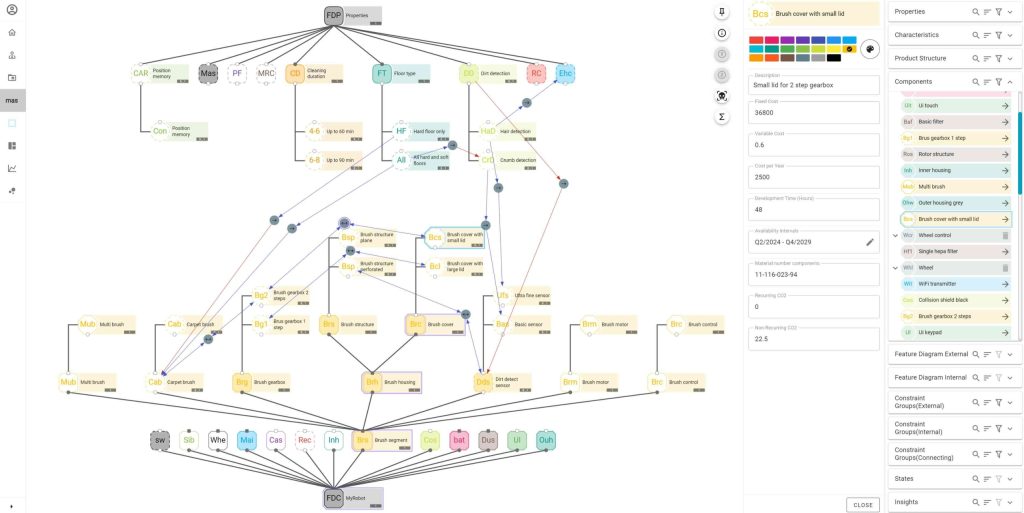
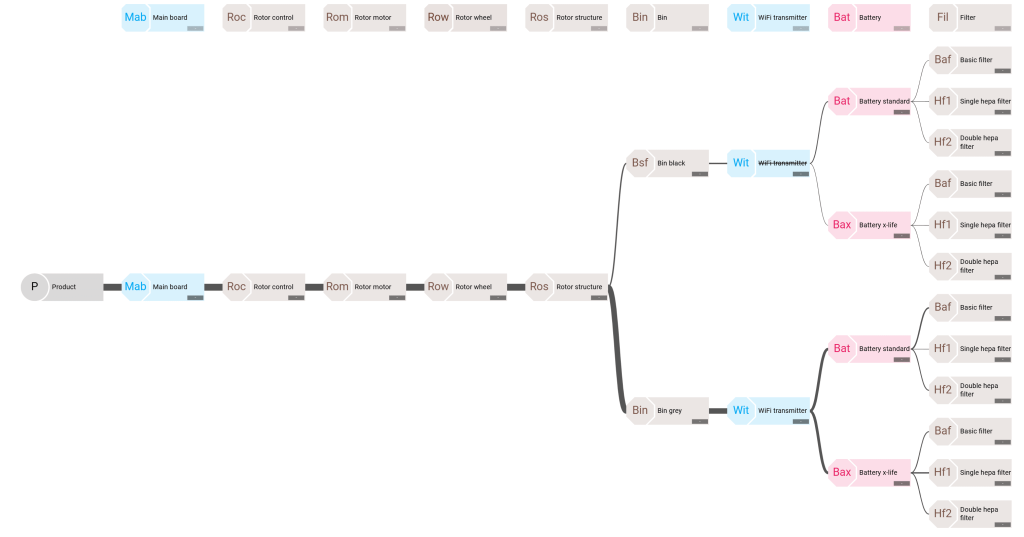
Modular construction kits are an important key to mastering growing product diversity while maintaining efficiency. They combine structured product development with strategic market adaptation – and create the basis for reuse, digitalization, and scaling.
A modular construction kit is more than the sum of its parts. It consists of a
modular product architecture,
defined variants and
characteristics of components and modules,
and the configuration rules that combine them in a meaningful way.
The result is a system that allows a large number of customer-specific products to be automatically derived from a small number of building blocks. This structure forms the basis for configuration and CPQ (Configure-Price-Quote), enables the digitalization of order processing and product development, and allows for significant economies of scale. The advantages are obvious:
Shorter delivery times
Lower storage costs
Greater predictability and
Cost-effective series production even for small batch sizes
All this makes modular construction kits a key tool in modern product development strategies.
Benefits
Overview of the advantages of modular systems
The modular principle as a success factor: The modular principle allows complex product ranges to be structured while maintaining market flexibility. It offers a balance between technical consolidation and customer-oriented customization. Modular systems are therefore not an end in themselves, but a lever for sustainable value creation: economical, scalable, and future-proof.
Proven in medical technology, mechanical engineering, electrical engineering, logistics, and many other industries
Process
Modular construction kit—how it works
A suitable modular system is not based on intuition, but on sound analysis and systematic development.
1
Modular focus and goals
Analysis of the product portfolio: Which products are relevant, which markets are strategically important, and what synergies are possible?
2
Modular product architecture
Translation of functions, technical structures, and customer-relevant features into modules
3
Features & configuration rules
Systematics of variant creation based on configurable modules and technical dependencies
4
Module cut along the supply chain
A look at process logic: What is relevant for purchasing, assembly, warehousing, and service? Which combinations lead to meaningful economies of scale?
5
Future market scenarios
Future market scenarios for simulating variant requirements, demand distribution, and technological leaps
6
Costs, ROI, CO₂, and quantities
Key figure simulation for informed decisions regarding economic efficiency and sustainability
7
Action strategies
Specific recommendations on rollout, development paths, storage strategies, or platform investments—data-driven and reliable
Our USP
Analysis based on real order data
Odego supports product development teams throughout all relevant phases – from initial analysis to implementation in day-to-day business. Together with the teams, the relevant content for modular development is tailored precisely to the progress of the project. Our experienced team guides you through the necessary steps, introduces best practices, and keeps the project on track. The Cquenz tool provides structured support for the entire process. All participants have access to the current status, variant rules, architecture decisions, and evaluation results at all times. This creates a common understanding, accelerates decisions, and increases transparency – across departmental boundaries.
These examples of modular systems in practice show how standardization and configurability can generate economic benefits without compromising the necessary product differentiation.
In this industry, modular systems reduce manual effort in order processing. Structured configuration and integration into digital processes make it possible to manage the wide variety of variants while still offering a high degree of customer customization.
Here, a modular design ensures scalability of production volumes. The reuse of technical assemblies simplifies validation and ensures cost certainty during market expansion.
The use of modular construction kits results in clear economies of scale and improved planning. This has a positive effect on delivery times, inventory levels, and investment planning.
The modular principle is based on combining predefined modules to create customized products. Clear rules and modular product architecture result in flexibility and high efficiency.
Modular systems are found in industries such as mechanical engineering, medical technology, packaging technology, pharmaceuticals, electrical engineering, logistics, and the defense industry—anywhere where variety must meet efficiency.
A construction kit is the concrete structure of a product with modules and rules. The construction kit system describes the overarching methodology, processes, and tools for use in the organization.
Volume effects, lower development costs, optimized assembly, and reduced variant maintenance allow resources to be used more efficiently—with positive effects on costs, time-to-market, and carbon footprint.
Newsletter subscription
Adding {{itemName}} to cart
Added {{itemName}} to cart
Loading...
This site is registered on wpml.org as a development site. Switch to a production site key to remove this banner.